Gilbey’s Bottle Store
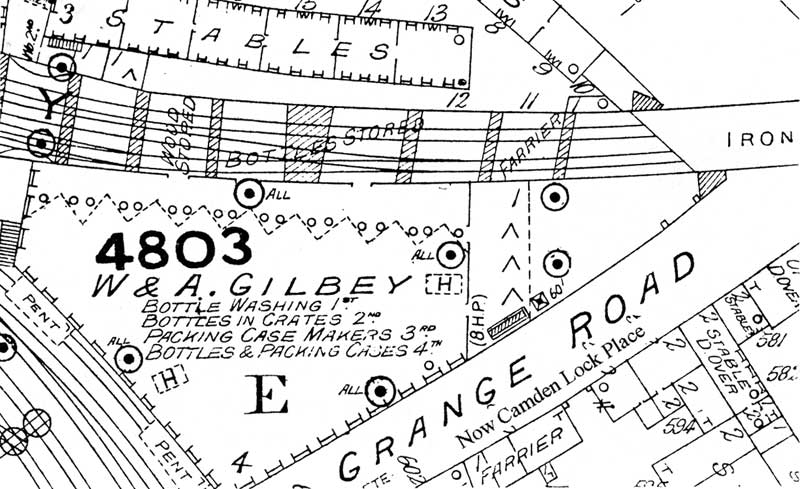
The Gilbey Bottle Store in Commercial Place was a handsome industrial building with brick outside walls and a slate roof. The Goad Fire Insurance plan of 1891, shows that it occupied the triangle between Camden Lock Place and the two railway lines. The plan shows ‘Bottle washing’ on the first floor, ‘Bottles in crates’ on the second, ‘Packing case makers’ on the third and ‘Bottles and packing cases’ on the fourth. The 1948 plan is identical, but shows sprinklers throughout. Inside were huge uncluttered floors built on metal joists resting on cast iron pillars.
 |
||
| Whole Map | Full Size Map | Full Size Map in New Window |
Goad Fire Insurance Map, 1891
When Gilbey’s left Camden Town, the building was used to store furniture and to forward it in crates by rail and road. The site was crammed with wood and the large open floors meant that, when fire struck in October 1980, it spread rapidly. The sprinkler system was not in working order, so that fire raced through the building unchecked. Firemen, unable to get inside, were reduced to spraying the fire from outside and dowsing all the neighbouring buildings to prevent the flames from spreading. The roof collapsed first, turning the building into a huge chimney and, as the floors and furniture burnt, the heat was concentrated on the cast iron pillars and joists. These expanded, pushing out the walls and collapsing the building in a mass of bricks and distorted iron work.
Eric Reynolds, who was in his Northside office on the other side of Camden Lock Place, watched the fire start, but was without a camera. The firemen (concentrating on closing the road, turning off the gas mains and spraying the buildings) did not notice when he went out of the building and slipped back again with a camera to take the pictures shown opposite. The fire smouldered for days. Later the site was cleared and lay derelict for years.
There was great controversy about the cause of the fire. People talked of arson by a maniac and also of deliberate destruction of the building for financial reasons. What these reasons could be in an area of such decay was not clear. The fact that the sprinkler system was not working at the time of the fire and that, according to newspaper reports, correspondence with Camden Council about repairing it stretched back for more than two years, added to the complaints. Some individual craftsmen who had workshops in the building, lost everything.

The Bottle Store after Gilbeys left. The Interchange Building is seen behind.1
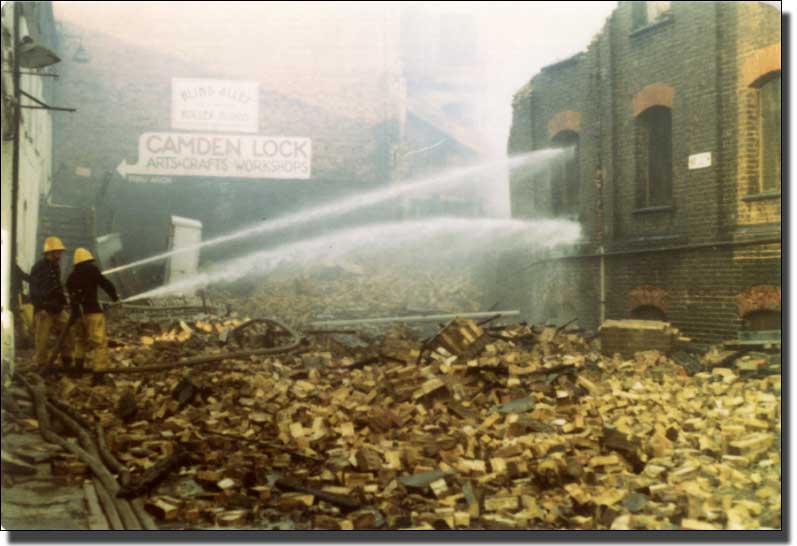
Firemen in Camden Lock Place spraying the area to contain the fire and prevent
it from spreading to other buildings. Bricks from the fallen walls cover the road.
the Interchange Warehouse is obscured by smoke and flames.2

The mass of steel joists and cast iron pillars a couple of days after the fire
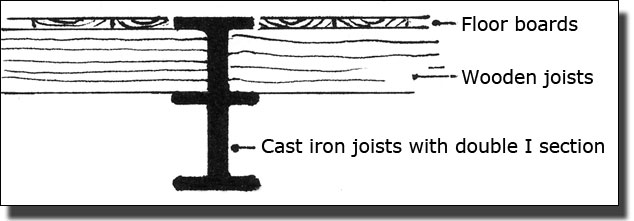
These photographs raise two technical points of great interest to anyone concerned with building history. Firstly, most girders are ‘I’ shaped, but here the ‘I’ has been doubled. Clearly the ends of the wooden floor joists were ledged in the top I and floor boards laid on top. Secondly, the moulded capitals at the top of the columns show that they were made of cast iron. The joists too can be seen to be made of cast iron, not mild steel, because they have stayed straight and one of them in the centre of the photograph has broken off. When mild steel expands in great heat, it bends and twists, whereas cast iron expands and stays straight. It sometimes then fractures. In the centre of the picture is a joist which has broken off short in this way. This shows that the interior of the building was a cast iron structure with cast iron joists, resting on cast iron pillars. Very Victorian. But not all the joists in the picture are ‘double I’.
Malcolm Tucker, who surveyed the building a few years before it was burnt down, says that it was, ‘in the same red brick style as No 2 Bond, but supported on heavy cruciform columns. Long-span timber floors, propped at mid span, as in No 2 Bond, by rolled steel beams, with rolled steel stanchions at ground level but timber stanchions above.’ One of these steel beams, with a single I section, can be seen in the foreground and the cast iron ones are higher up the picture.
++PICTURE TO BE TAKEN OF THE NEW BUILDING OR COLLECTED FROM STABLES MARKET ITSELF WITH TEXT
In 1998, Stables Market had opened new doors at the corner of Chalk Farm Road and Camden Lock Place (the old Grange Road). These led to the site of the old Gilbey’s Bottle Store. There were new lock-up market kiosks on the site and The Stables Market applied to erect a permanent building there.
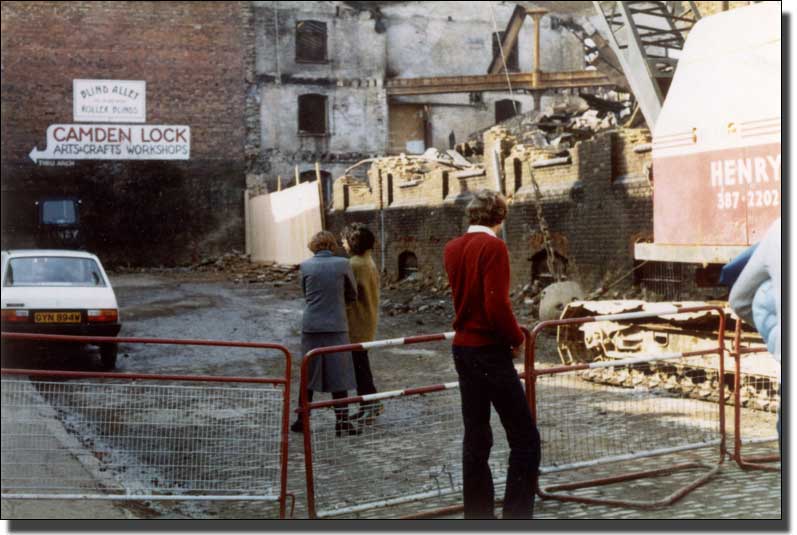
The final demolition with a ball and chain.3
++Footnote - check
