A Sequence of Maps of Stoke NewingtonPart 1: Until 1868This series of maps of Stoke Newington tells the story of the development of the area as no words can do. They outline the changes from a tiny village to the crowded streets of today. You can compare different maps and notice the changes, or by searching links to other sites, find out more about the houses built in the time of a particular map and other details of the period. You can move forwards and backwards, or stand still for a moment. There is more information on each map and
a larger version is available by clicking on the maps below. |
|
John Speed 1611 John Speed's map shows what a tiny part of our modern London was built up. The Cities of London and Westminster clustered on the north bank of the Thames. London was inside its city walls and London Bridge,the single bridge over the Thames, while Westminster sprawled round Thorney Island and its ford. The main highway was the river, which was unenbanked of course. The river controlled everything and all Londoners were aware of the tide in a way recent generations have never learnt. Mistress Quickley telling of Falstaff's death said, 'Nay sure he's not in hell; he's in Arthur's bosom, if ever a man went to Arthur's bosom. A'parted even just between twelve and one, even at the turning of the tide --' London was tiny and anyone who lived outside it, lived in a village. Speed shows the villages of Clerkenwell, Islington, Kings-land, Canonbury, and Newington Green, with Shakerwell and Newington (presumably Stoke Newington) both on the edges of the Hackney Brook.
|
||||||
|
|||||||
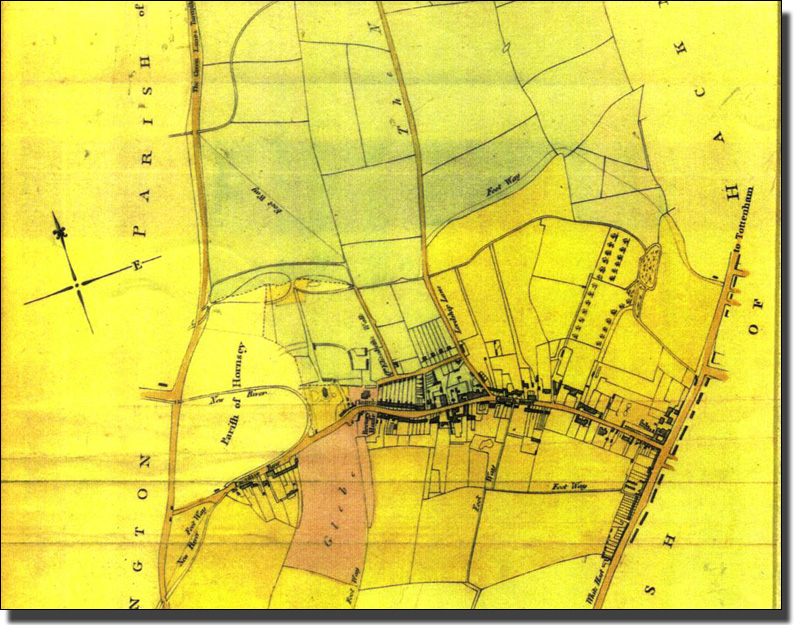
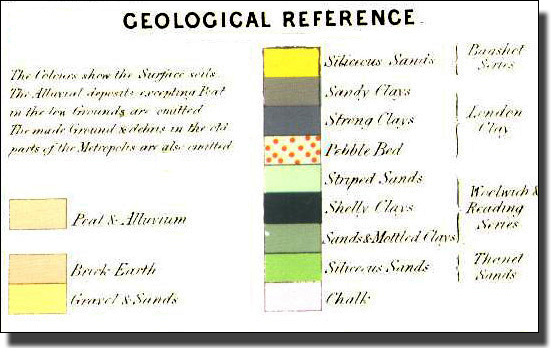
Years before any of the present Stoke Newington schools were built there were a number of important maps, including two or three very local ones. In 1734 Stoke Newington was far out in the country, a land of farms and woodland, with one gravel road joining Stoke Newington High Street and Green Lanes. This was Stoke Newington Church Street, with its tiny old Tudor St Mary’s Church, even smaller than it is today. The Hackney Brook rose in some streams near our present Grazebrook Road, ran round the northern edge of Abney Park Cemetery and away into Hackney. The ground south of the river was Gravel, while the land north of the river was Clay. Clay is sticky and difficult to build on. Gravel drains well, gives dry walking and allows one to dig wells to the water below. Therefore Church Street was built south of the Hackney Brook and the gravel land between Church Street and Newington Green was filled with houses long before the builders started on the clay lands to the north (see the 1810 Sale Map later). Lady Abney owned a large estate of valuable farmland and woods, north of Church Street. It ran up to Woodberry Down Meadow, near our modern Manor House Underground Station. She had a map made of her estate in 1734. |
||||||||||||||||||||||
The 1734 Lady Abney Estate Map of Stoke NewingtonA very local mapThe map was drawn with north to the left. We are more used to seeing maps with north to the top
The 1734 Field NamesLook at the field names on the 1734 map. Some describe the shape of the field or its position – Lower Long Wood, Crooked Lane Field, Straight Lane Field, Old Cut Meadow (where a long bend in the New River had been shortened). Some describe how the field was used – West Tile Pits, Milk Field. This was in the centre of the estate, so twice a day the cattle must have been driven there from the surrounding fields for milking. Some names describe the flowers and birds - Primrose Meadow, Cowslip Meadow, and Lark Field. How long is it since a lark nested in the grassy Woodberry Down? It is interesting that someone once said, "The nightingales are in full song in Stoke Newington."
The map has been turned so that the small piece of Church Street is at the bottom and the present Manor House area is at the top. This map takes us right back to a pleasant Stoke Newington unchanged for years. Look at the field names. How often have the people living in the Woodberry Down flats which were built on Lark Field, heard a lark in the garden. The country field names come from a completely different world. There is a mistake on this map showing that it was copied from an earlier one. The buildings shown on this map in Stoke Newington Church Street, are the outhouses of the old Manor House but, by 1734, these had been demolished. The houses called Church Row, which replaced the Manor House, were built before this map and are on the 1814 one. The Lost Church Row Houses |
||||||||||||||||||||||
|
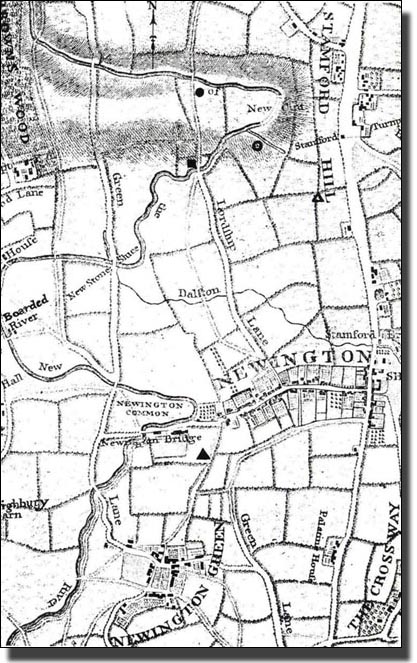
The 1741 John Rocque Map1741 John Rocque's Map shows the small villages of Stoke Newington and Newington Green in a green landscape of meadows, with the New River snaking through it, following the contours of the land. Rocque shows his hills, not with contour lines as we do today, but by shading. From Newington Green in the South there was a gradual rise for about two miles to the ridge on the Tottenham (now Harringay) border in the north. This ridge at Woodberry Down and Seven Sisters Road is shaded on both sides. This ridge was the reason why the New River had to snake so far east before it could break through the ridge and continue south. John Rocque shows a countryside with very large fields. These are not accurate as comparison with the 1734 Estate map and Milne's map of 1800 show. |
||||||
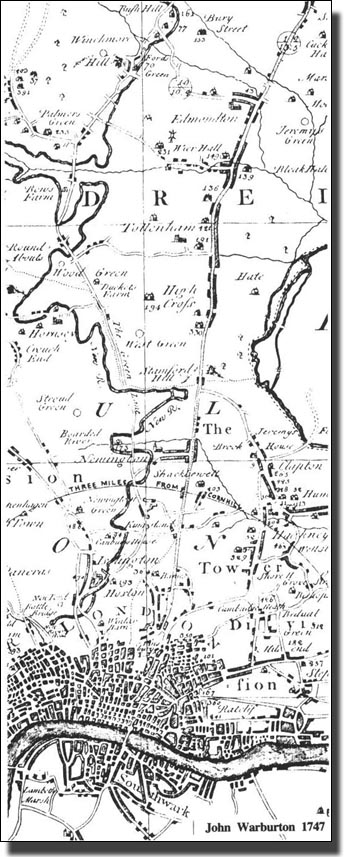
The 1747 John Warburton MapJohn Warburton’s map of 1747 is drawn very differently from Speed’s map. The pointed hills have gone and roads are marked as double lines. There is no attempt to show hills. There was not room for both roads and hills at this scale. The map shows that New River had been built a few years earlier, snaking its way for forty miles along the contours, round hills and valleys, to bring clean water all the way from the springs at Ware to London. It flowed through the open fields as it still does today through Finsbury Park and round the valley of Eade Road and the ridge of Woodberry Down. The Reservoirs had not yet been built Stamford Hill and Newington are named on the map. In those days Green Lanes, running from left to right, was really green. There would have been a few tethered animals and perhaps a young child tending a flock of geese, though the geese were probably far better able to look after themselves than was any child.
|
|
||||||
|
1800 Milne's Land Usage MapMilne's Land Usage Map shows how the different fields were used at that
period. This was the first London Land Use Map and showed this by tiny
letters in the corners of the fields and by colour. The London Topographical
Edition is a revelation London in 1800
|
|||||||||||||||||||||||||||
By the end of the Eighteenth Century, the parts of the Stoke Newington and Brownswood estates south of Church Street had become the property of the Earl of Darlington and he decided to sell. His land would make a greater return if he could attract speculative builders to his land. He would be the Ground Landlord. They would build houses and roads and sell them or lease them as soon as they could. AS the Ground Landlord, the Earl of Darlington would charge the new householders ground rents for living on his land for ever and ever. In 1810 sixty-seven acres of the Stoke Newington and Brownswood Estates were offered for sale in twenty seven lots. It was called ‘A valuable Copyhold Estate of Inheritance, held under the Manor of Stoke Newington’ and was described as ’remarkably rich and fertile Meadow, Garden, and Nursery Ground’ and ‘Abounding in every Part with valuable Brick Earth, of considerable Depth. |
||||||||||||||||||||||||||||
This diagram how the land was used at the start of the Nineteenth Century Diagram from the Introduction to the The central area inside the dotted line was built over. Just outside it was a ring of kilns, burning tiles and bricks for the new houses still being built, while the farming was still going on around them, just as before. Stoke Newington must have been part of this ring at that time. |
||||||||||||||||||||||||||||
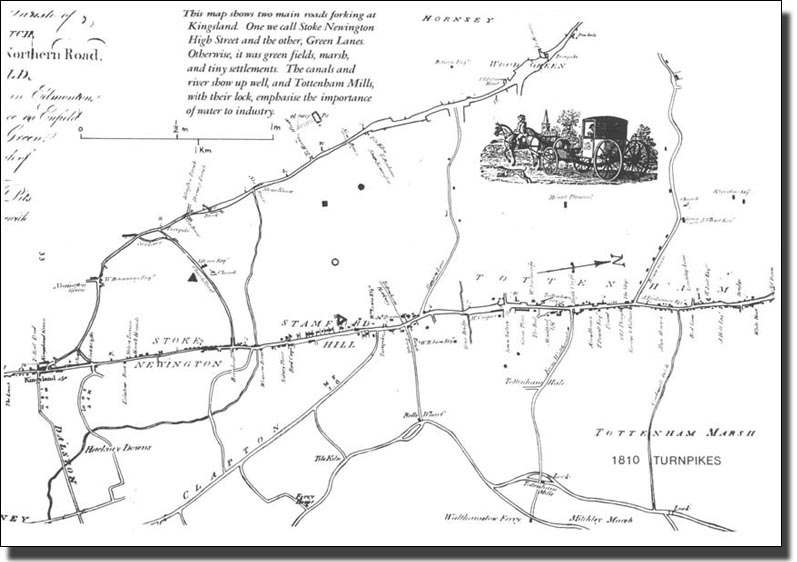
1810 Turnpike MapThis map shows that Green Lanes had become a turnpike road, with a toll gate at the corner just beyond Stoke Newington Church Street. For centuries roads had been the responsibility of the local townspeople and villages. Local villagers hardly moved outside their own neighbourhoods. Building roads at the villagers’ expense for other people to drive along, was regarded as an imposition. This meant that many roads were badly built and maintained, so Parliament passed Turnpike Acts. These allowed Turnpike Companies to take over long stretches of major roads, resurface them and charge travellers to use them. Toll gates and toll houses cutoff the road in sections. People, vehicles and animals were charged for travelling along each stretch, so one needed plenty of small change. One toll gate was erected in Green Lanes at the corner of Clissold Park and another in Manor Road. In Pride and Prejudice D'Arcy says "What are fifty miles with good friends?" He was probably the first person in fiction who could have said this. |
||||||
1810 Darlington Sale Map
The 1810 sale was a failure because the Estate could not offer leases of more than thirty years and builders could not sell houses with such short leases. An Act of Parliament was required before longer leases could be offered. This needed a new map. This map was published in 1812 and the Act was passed in 1814.
|
|
||||||||
(Photograph by courtesy of Hackney Archive) |
|||||||||
By 1814 people were starting to move out of Cities of London and Westminster into the country fields of Stoke Newington. It was only a trickle at that time, but later it would become a flood. Landlords were only too anxious to have people build houses on their land and to be able to charge the new householders Ground Rent for ever after. This would be much more profitable than using the fields for farming. To do this they needed an Estate Map and this was made in 1814. The 1734 map of the Lady Abney Estate and the 1810 map of the area south of Church Street down to Newington Green were surveyed to form the Map of the Prebendal Manor of Stoke Newington of 1814. The Manor was the property of St Paul 's Cathedral and the churchmen, who were put in charge, and given this valuable living, were called Prebends. Hence ‘Prebendary Map' |
||||||
The 1814 Prebendary map with the
|
||||||
|
||||||
The Central part of the Prebendary map showing Church Street running from the High Street to Green Lanes, just south of the Hackney Brook. Houses line Church Street but only a small block around St Mary's Primary School and up to Yoakley Road has been developed beyond it. |
||||||
(From the Derek Baker Collection) |
||||||
The southern third of the map reaches to Newington Green and the Islington border. Parts of this area were not on the Parish of Stoke Newington, but in Hornsey. Over the centuries people left land to different religious foundations and it came under the control of sometimes distant churches and parishes. Queen's Park belonged to Chelsea; these fields belonged to Hornsey: and so on. This led to enormous confusion when different districts had to deal with sewerage, rubbish collection, education, and other systems. Parish relief became even more complicated. Householders had to pay rates to distant authorities, who then had to pay the local authorities to do work for them. It was not until 1900 that the muddle was cleared up and these fields in Stoke Newington, by then fields of houses, became part of Stoke Newington once again. |
||||||
The 1810 sale had been a failure but there was a more successful sale in 1821. The second Sale of the Darlington Estate took place in 1821. Thomas Cubitt and his brother William bought a number of plots and built Albion Road. Stoke Newington in 1921, showing plots purchased by
|
The 1828 Cruchley Map |
|||||||||
|
|||||||||
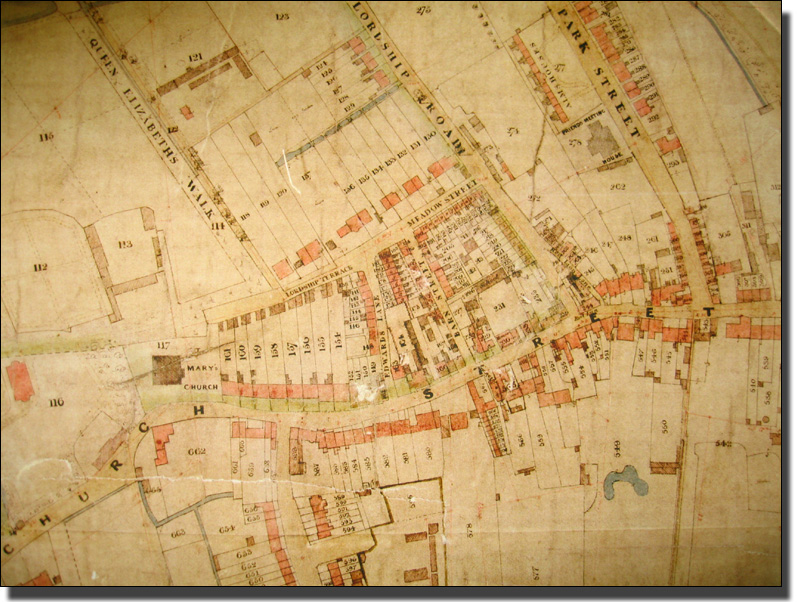
(Printed by courtesy of Hackney Archive) The 1846 Tithe MapThe 1846 Tithe map, which is in colour, numbers every plot in the estate. it was also printed in Black and white, but without the numbers, as The Parish Map Of Stoke Newington as shown below. |
||||||
The Parish Maps of 1846 and 1855 |
|||||||
|
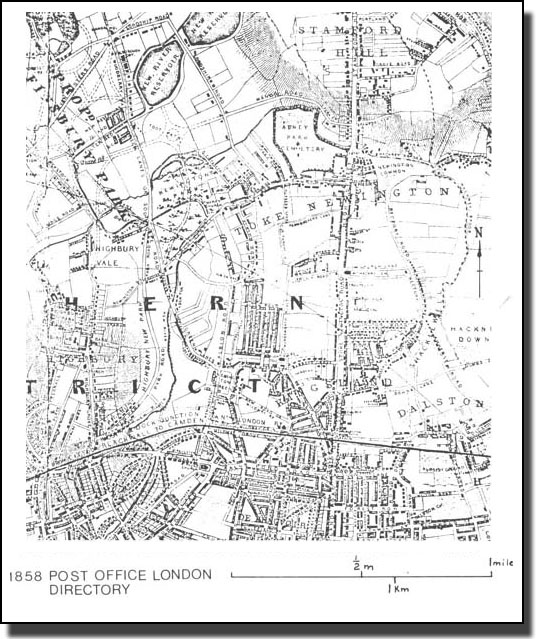
The Parish Maps of 1846 and 1855 give a detailed plan of the street layout. Many of these boundaries persist to today and could be identified. In 1858 the Post Office published a map and numbered the houses, because addresses were often difficult to find. 'Mr Jones's house, near the Butchers in Church Street', is too vague for comfort. This map shows several planned street layouts, many of which were later altered, but Stoke Newington was poised for immense changes in the next couple of decades. Use the full size map to see it in more detail.
|
||||||
| (Printed by courtesy of Hackney Archive) | |||||||
The Post Office Map of 1855
1855 Parish of St Mary, Stoke Newington |
|||||||||||||||
| ||||||