William Patten Primary School
Walk 1: A Walk Round the Local Houses
This is designed as a simple walk to look at local houses within a few minutes of the school gates and without having to cross any major roads. Indeed, a great deal can be examined closely without having to cross any roads at all.
Start at the school gates in Church Street

 |
Walk 1 | Walk along Laycel, Kersley, Kyneston and Dynevor Roads |
 |
Walk 2 | Walk along Church Street, Defoe, Kynaston and Oldfield Roads - through the passage to Defoe Road and back along Church Street |
The Routes of William Patten School Walks
Walk 1. (Coloured Orange on the map)
Opposite the school are some buildings which have not altered much since 1914. One building is completely new. This Walk will help you to sort out the old from the new. You will also find buildings which have not been altered much. They may have new shop fronts, windows changed, or extra floors added, but the actual buildings are still much the same as they have been for years. The Walk may be very short, but it contains a lot of changes. Our job is to find what has happened to the local buildings in the last hundred years.

Turn left at the School Gates. Go along Church Street and turn into Lancell Street. Walk to near the end and turn back, Turn left again into Kersley Road.

The School Site in 1914

Stoke Newington Church Street from the gates of William Patten School
The picture shows the end of the Fresh Foods restoration buildings and some of the earlier blocks further down the road. They have the curved window heads and old style sash windows. These are the typical Church Street buildings with little alteration sine perhaps 1860. The shop fronts have been changed and painted different colours. The brickwork of the corner building has been rendered with sand and cement and painted white, but the buildings themselves have been little altered.
This view of the High Street is much as it has been for a century but the the buildings have been renovated and shop fronts have been changed considerably. There is one shop front with two small curved heads which has not changed much. When built they would all have looked like this, but most now have huge modern plate glass fronts. It is interesting to compare the shop fronts and decide which are old and which are new. |
The Lintels to the Windows
The buildings are in yellow/grey London Stock bricks, with red brick window heads (Lintels) and brick aprons below the windows. It is not clear if the keystones in the window heads are in stone or plaster. These brick lintels were specially moulded at the brickyards and brought to the building sites in wooden boxes. The bricks are wedge shaped and press sideways on each other. They all want to fall down at the same but they are pressed against each other and cannot do so. They are each so eager to fall that none of them can do it. If one brick was removed the whole row would fall.
Bricks and Building Forms
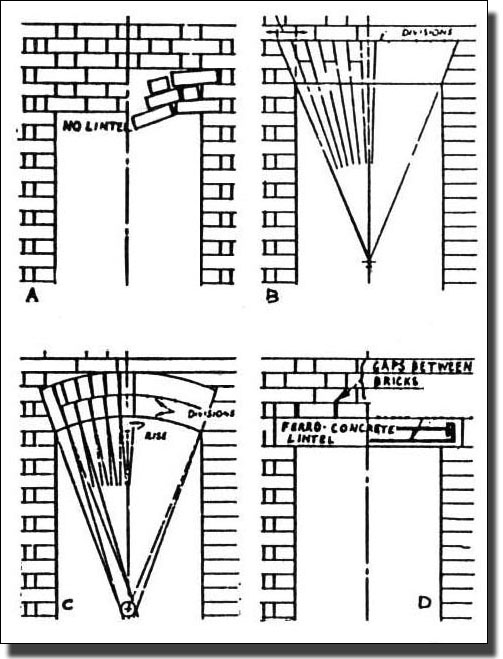
All openings in brick walls need some way of keeping up the bricks above the openings. This may be an arch, or a flat lintel of some kind. Above are different forms of flat lintels.
Brick lintels
Fig. A. A brick wall with and without a lintel. Fig. B. The setting out of a brick arch with wedge-shaped bricks. Fig. C. The setting out of a rough brick arch. These are normal bricks and the wedges are formed with mortar. Fig. D. A ferro-concrete lintel is the modern solution to the problem. Some builders use steel lintels and wooden ones used to be common, but these were often attacked by dry rot were. |


Lintels are designed to support the bricks above windows,
doorways and other openings.
The Completely New Building.
It is obvious that this building is new. The bricks are new and everything is still bright. It is also built completely differently.
- It follows the curve of the roadway so as to use every inch of the site.
- The ground floor shop is set back behind pillars. No other building in the street is like that.
- The great difference between this new building and the old ones next door, is the construction. The old buildings are in brick and the brickwork supports the weight of the buildings. The new one is in ferro-concrete. It is built as a series of ferro-concrete floors supported on pillars. The brickwork here is only there to keep out the draughts It supports itself, but not more.
- The architect has been very careful to make his new building fit the street. The building is the same height as the old ones next door. The pediment matches the next door one exactly and the shop front height and colour match. I suspect that the actual roof of the new building is slightly higher than the old ones, but we cannot see it.
- There are three major changes. In the old buildings the first floor is taller than the second floor. This is usual in old buildings, In the new one the first and second floors are the same height, so the white band separating them has been lifted.
- The new widows are different from the old ones. The old windows were sash windows with top and bottom sliding sashes and keystones painted white. These have been replaced with modern metal windows which hinge upwards. One is open in the picture.
- The new windows in the curve run the full height of the floor to give maximum light. Architects often emphasise corner buildings and these tall windows do it quietly and well.
- The first floor brickwork in the old buildings has been replaced with the same bricks as the new building. This disguises the difference between the old and new buildings cleverly.
How did the new building come about?
The Site in 1868

The site in 1914
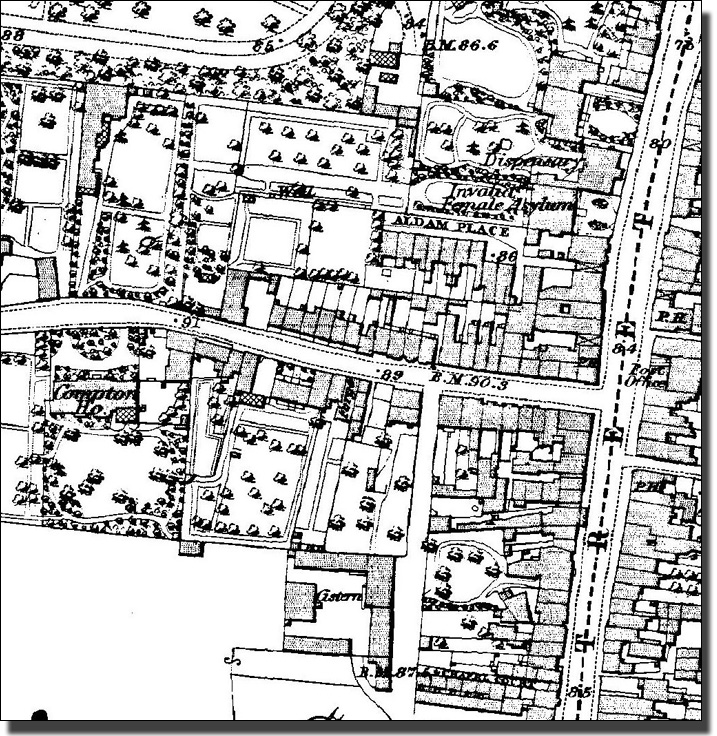
The 1868 map shows houses with large gardens opposite what would become the William Patten School site. By 1814 these had been demolished and a timber yard occupied the site. After about 1980, when Stoke Newington Church Street was declared a Conservation Area, the Timber Yard became valuable building land. It was sold off and a new, curving road was built. It was this curve which suggested the shape of the new building. All the rest is careful thought.
Route
Turn left at the School Gates. Go along Church Street and turn into Lancell Street. Walk to near the end and turn back, Turn left again into Kersley Road.

The original houses in Lancell Street
About 1875 the houses with large gardens in Church Street were being sold off. The chapter on Stoke Newington Estates shows some of these valuable building sites. Developers could put a row of houses on some gardens. The centre of London was being developed, with new railway stations, new sewers, new main roads, so that it was an enormous building site. From 1960-80 nine tenths of London’s inhabitants fled. Many came to Stoke Newington and these were some of the new houses they moved to.
Link to John Summerson, ‘The London Building World 1860-1880.’
There are lots of roads full of houses like this in Stoke Newington.

A row of Victorian Gothic houses
This house design became very popular in the eighteen There are plenty to be found in local streets.
The Welsh Slate roofs are fairly steep, though not so steep as some of this type. These have white-painted barge boards with curly edges and small, pointed finials, like tiny flag posts, at the top. The ones in Lancel Road have straight barge boards and no finials, but this is a minor difference. The houses have Roman arches over the doors and semicircular transoms over the doors to let light into the hall. The Roman arches have been cut off in both sides, as there is not enough room for more.
The builder made the house frontages small so that he could pack a lot of houses on the site, but he wanted to make his houses attractive so that they would sell, so he added lots of interesting details. A pair of red brick quoins runs up the front of each house, contrasting with the yellow of the London Stock Bricks. (Quoin is French for corner). These ones are not really corners: just decorative features to show off the bricklayer’s skill. The houses have three-sided bays covered in stucco and painted. Wherever you see houses of this type in Stoke Newington, they date from roughly 1875 to 1890.
The houses on the other side of the road were of the same design but they have been demolished to extend the William Patten School site.

The east side of Lancell Street in 1975 before it was demolished
to extend William Patten School site.

William Patten Primary School from Lancell Street

The Kersley Road and Church Street corner
This house had three storeys originally but a fourth storey has been added behind a slate Mansard Roof. These roofs are built of timber and slate and are light in weight. A brick extension would have been heavy, perhaps causing problems with the foundations, expensive, and would have taken much longer to build. Today the slates are backed with heat insulation of some sort. When Mansard invented the design for King Louis the Fourteenth, the wind whistled through the slates. As only the servant lived up there, it did not matter to Louis.

New Houses in Kersley Road
These new houses have curved window heads, echoing he shape of the Ruskin houses we shall see nearby. The houses have sash windows, again like other local houses. They are attempts by the architect to make his new houses blend into the older ones, without pretending to be old. The slate roofs have a gentle slope and have Velux windows let into them to light the top floors in some way. Notice that the roofs are built in one long slope so that the backs of the houses are higher than the fronts. The architect has gained some extra space secretly, without raising the fronts of the house. There are Velux windows in the roof, so people probably live up there.
The road slopes down slightly, so the architect has built each pair of houses level, but a few inches below the next pair. On steep slopes this can make the house look like saw teeth. Here the slope is very gentle.

Dumont Road
These houses, like hundreds in the area are Bye-lawhouses.
Bye-law Houses to Give People Clean Air.
By the 1860s small terraced cottages were being built everywhere, narrow and small. Landlords wanted short road frontages (which were cheaper as they could crowd in more houses). Secondly, they wanted to build over part of the the gardens, so that their houses were three rooms thick. Landlords built rooms leading out of other rooms, so that inner ones might have had no windows opening to sunlight or fresh air at all. They wanted more and more rooms in less and less space. What had once been gardens, became covered with warrens of interlinking tenements, airless ad insanitary.
Local authorities had other ideas. They were faced with bad health problems due to pollution, and poor diet. Tuberculosis was rife. Streptomycin, our modern cure for Tuberculosis, would not be not invented until the1950s. When these houses were built, in the second half of the Nineteenth Century, thousands of people were dying of tubeculosis every year.The only known cure for Tuberculosis was plenty of clean air. The rich could go to the warmth of Egypt or the clean air of Switzerland. People needed fresh air and landlords were building unhealthy, airless dens. It was rather like shops selling junk food today.
Instead Local Authorities demanded healthy buildings with through draughts in every room. New bye-laws made by the local authorities, not central government, insistd that every inhabited room had to have windows which could be opened to the air and these had to be of a size related to the floor area of the room. The bigger the room, the bigger the window. This would reduce fevers and contagious disease by allowing the free passage of air into every, room, These regulations led to The Bye-Law House, with its Back Addition and typical L shaped plan. It gave each house three thicknesses of rooms, all with windows to fresh air, instead of the normal two. The design swept the country.
The 1867-77 plan below shows a terraced cottage built by the Artizans, Labourers, and General Dwellings Company, at Queen s Park and Noel Park. Crammmed on a fifteen foot frontage are two small rooms with a a scullery in the Back Addition behind, Above are three bedrooms. The W, C, is outside built as part of the house. Small front and back gardens complete a long narrow site 15 ft (13 metres) by 70 ft (64 metres). Built to be rented at seven or eight shillings a week, these cottages were very popular. Today they are fashionable and very expensive. Every room opens to light and air.

Plan of a small Bye-Law house on a narrow frontage
The frontages varied by a few feet bit the principle was the same.

Dumont Road

Dumont Road corner house
++TAKE ANOTHER PICTURE TO SHOW THE BACK ADDITION AND EXPLAIN WHY BACK ADDITIONS WERE INTRODUCED. USE BYE LAW HOUSES IN M&P THIS TO BE A STANDARD TEXT IN ALL SCHOOL WALKS.
This end view of the terrace is interesting because the front roof is shorter than the rear one. The architect may have decided to make his rear rooms slightly longer that the front ones and placed his chimneys to suit. Either that or the rear rooms have slightly lower ceilings.

Dynevor Road Plasterwork
These two houses have been carefully redecorated and almost all of the original features have been preserved. The houses have sash windows, with a top and bottom ‘light’. The window heads have a delicate curve, typical of Ruskin houses. Why are the top window panes in front of the bottom ones?
Inside the windows are the original protective shutters, painted white. Others further down the road have been left with bare wood, or perhaps they were painted once and have been stripped. These shutters fold back during the day. At night they are opened out and locked with long steel bars. Obviously they give protection against burglars, but why do they not reach the top of the windows?

Dynevor Road plasterwork detail
The plasterwork is elaborate, round pillars at the doors and windows and foliate capitals. This type of capital, decorated with flowers and fruit was first introduced by John Ruskin about 1860 and can be used to date the houses. Here the plasterers were experimenting with decorative forms and they let their imaginations run free.

William Patten Primary School from Dumont Road
++FIND A PICTURE OF THE SCHOOL FROM THIS
POSITION BEFORE THE ROOF PLAYGROUND WAS ADDED.
++LINK TO THE PROPOSED ENLARGEMENT OF THE SCHOOL c AD 1970
